My first game review! I’ve been playing a good number of games lately, thanks to the release of the Nintendo Switch, and I felt that after playing the ambitiously designed game that is Xenoblade Chronicles 2 I just had to write about my experiences on it.

Story
Xenoblade Chronicles 2 (XC2) is a Japanese RPG where the protagonist Rex, a 15-year boy full of optimism who makes a living by salvaging the cloudy seas in the world of Alrest for sunken treasures, accepts a job from the chairman of the nation Argentum Trade Guild. This job leads him to what this series calls a “Blade,” a human weapon that only lives through a bond with its owner, also known as a “Driver.” This Blade just so happens to be one of the most powerful Blades in existence, known as the “Aegis.” With the Blade’s sheer power, it has marked itself as a legend known throughout history of Alrest. Anyone who finds out that this Aegis exists – and realizes that the legends are true – wants to claim it as their own.

Rex discovers this Aegis, known as Pyra, after a near-death experience while on the job. On the cost of saving Rex’s life, Pyra asks of him one request: to search for the land of Elysium, a land of paradise where everyone lived in harmony. The game’s story revolves around this quest of Rex getting Pyra there, protecting her at all costs.
Character Development
Throughout the story, Rex comes across many partners who are willing to help him get Pyra to Elysium, on top of all the enemies that try to stop their path and claim the Aegis for themselves. All these characters have their own journey of character development that gets us so emotionally invested in.
Rex: As a good-hearted boy who’s spent most of his live salvaging for treasures to send back home to his family, he’s suddenly caught up in a world of fighting and adventures all around. We as players grow with him as he learns about Pyra and her history. He becomes a stronger Driver – with no Driver experience beforehand – as the story progresses, learning how to fight and discovering new skills as the story progresses. As he grows, his optimism acts as a motivator for everyone else to accomplish their goals. I can actually relate to Rex quite a bit as people tell me I can be a bit overly optimistic sometimes, but it works! Optimism paired with courage goes a long way.
Pyra: Her history (and the main history of Alrest) predates back 500 years. We learn about the reasons why she acts the way she is: a kind, gentle being with powerful inner (and outer) strength, but with guilts and doubts from what she’s done back then. Rex’s optimism brings out the best in her as the story progresses.
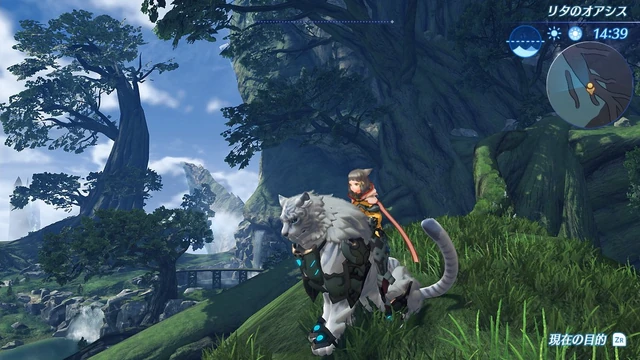
Nia: A Driver who initially was paired with Rex and others on the initial job from the chairman, she and Rex are the only ones on that job who shared similar values so they began to grow as friends that way (the two others on that job turn out to be the two biggest antagonists in the story). After Rex discovers Pyra, the two and Nia end up in an unknown land, so the three end up adventuring together trying to find a land of civilization. That civilization turns out to be Nia’s homeland. Nia originally intended to stick with Rex and Pyra until they made it safely to her home, but Rex pleads Nia to stay and help them reach Elysium, with Nia’s developed Driver skills. Nia’s sassy and sarcastic personality hides the truth of who she is, but as she ventures with the others to Elysium, the truth reveals both her true form and her true power. Nia’s Blade, Dromarch, is a white beast full of wisdom that balances out with Nia’s personality as he tries to keep her mind open during the worst of times.

Morag: Known as the Special Inquistor of the nation Mor Ardain, also known as the “Flamebringer,” this Driver is first introduced to the story as a powerful antagonist, stopping Rex and Pyra from getting to Elysium. However, her intentions differ from others, in that she and her Blade Brighid want to stop the Aegis’s power from causing any harm onto the world, a motive we can empathize with despite her being the villain. Her open-mindedness, a trait you rarely see in antagonists, ends up having her join the team, as she rethinks her beliefs when she sees Rex’s and Pyra’s motives.
There are plenty of other characters unmentioned who go through similar depths of character development, which makes the game interesting the entire way, despite the game’s notoriety for lasting at least 80 hours. The ample number of cutscenes within the game allow the writers to go more in-depth in these characters, leaving a much richer experience.
Exploration
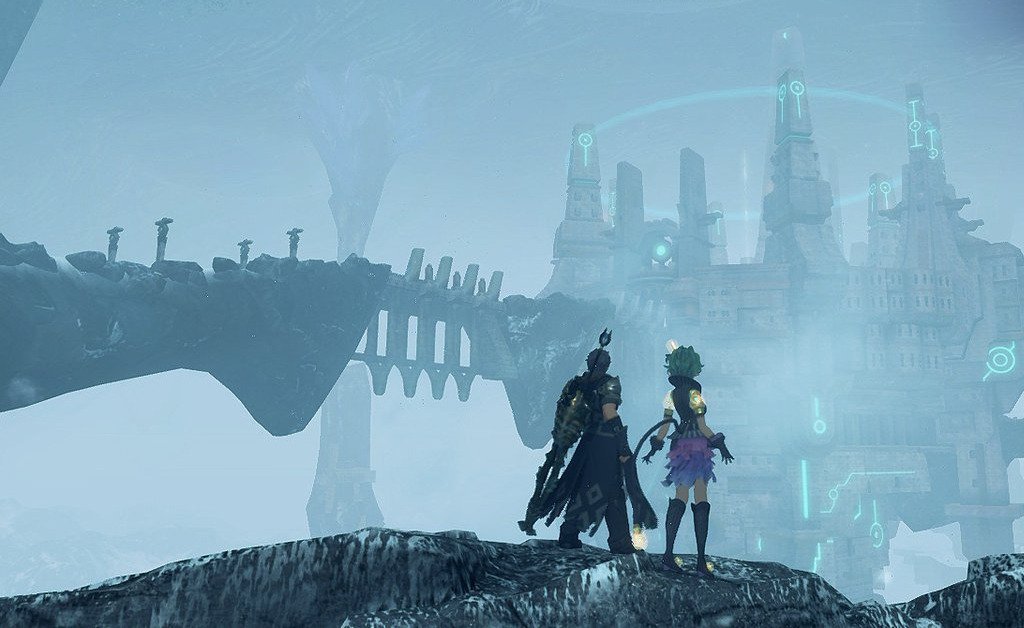
Just look at how much detail they put into these worlds!
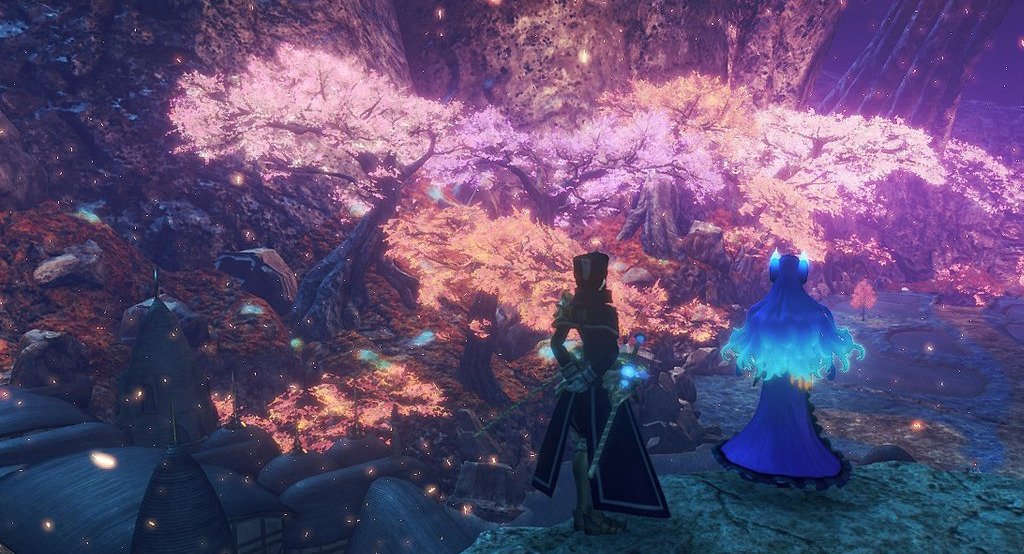
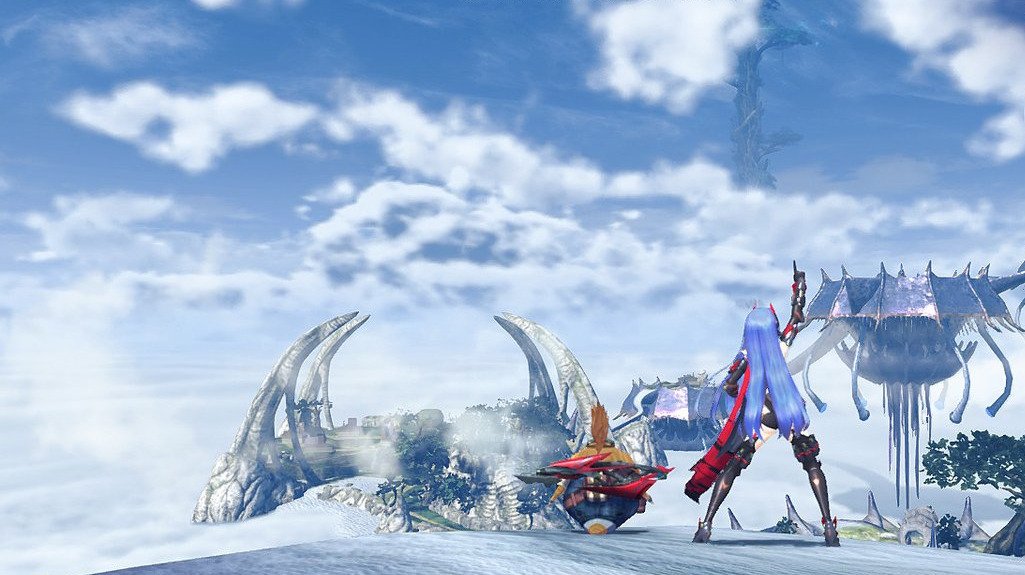
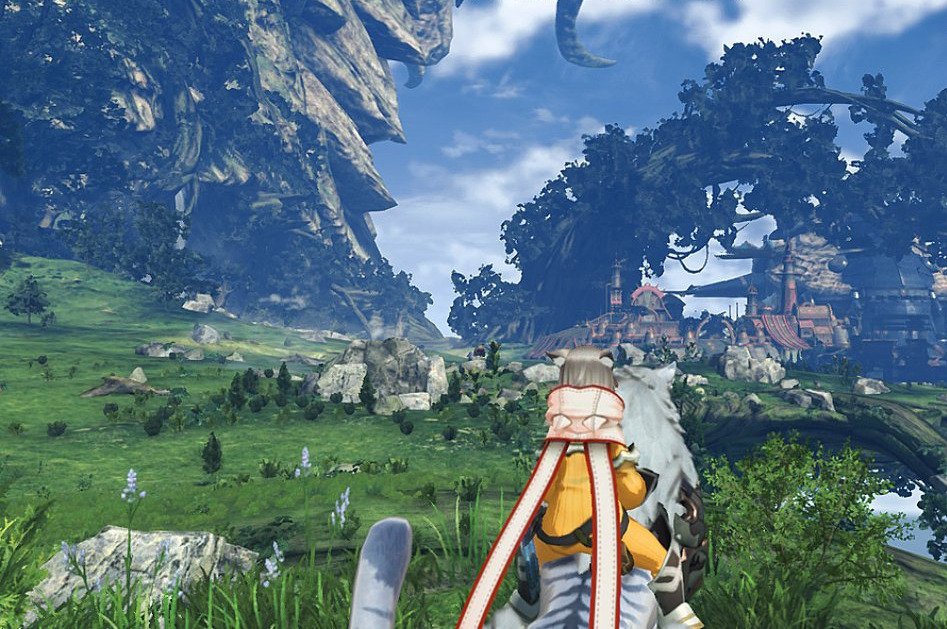
Source: https://akagura.tumblr.com/post/168735944964/screenshots-of-the-main-cast-from-xenobladehttps://akagura.tumblr.com/post/168735944964/screenshots-of-the-main-cast-from-xenoblade
There is so much attention put into these contrasting worlds. Whether venturing through the main story or the game’s plethora of side quests, I caught myself just moving the camera around for the sole sake of appreciating the artwork and world building put into this game. The only notable issue I saw was when you teleport to a different nation, it takes a while for the game to render everything (which just shows how much detail there is to everything). It’s not too offputting, but it is kind of odd to see for example a treasure chest show up the first second just as an ordinary box, then three to find seconds later only then loading the wooden details, and another few seconds later its shine.
On top of the amazing visuals, the music is absolutely more than fitting in each world – the experience actually feels more immersive thanks to the music. Some places I actually hated exploring thanks to how eerie the music was, or how powerful the music was when trapped in a desolate land surrounded by enemies stronger than I was. Other times, the music helped climbing up a mountain through a snowstorm actually felt like an adventure that I wanted to plow through. The music has such a strong influence on the experience; you simply cannot play the game without having it on mute.
Fight!
The fighting mechanics in this game are quite unique, requiring more strategic timing than mashing buttons to claim victory. The first fight starts off so simple that it made me a bit hesitant to continue – you literally don’t have to press any buttons to attack, and therefore to win your first battle. However, the mechanics build upon each other over time, making each boss fight a unique experience.
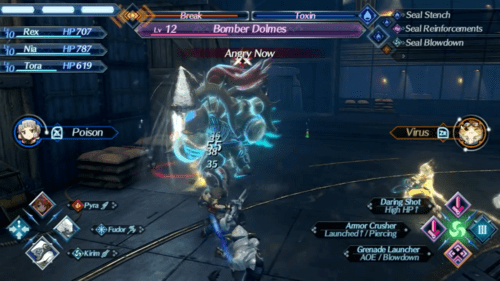
Frankly it is quite a bit to take in, and with so many little tricks to implement it can be a bit overwhelming. The game also does a subpar job in introducing these mechanics; it simply states what you need to do in text, sometimes but not always requiring you to do said mechanic to close the text, then the fight continues as normal. Usually, for mechanics that require you to press said buttons to close the text, those were easy enough to get a hang of, as it does only require pressing a button. However, for more intricate game mechanics that require for example stringing together a chain of attacks first, it can be easy to forget what the text said. You can’t find the tutorial text anywhere after going through it the first time either. The nomenclature of these mechanics can be confusing and overwhelming as well: “driver combo,” “joint combo,” “fusion combo,” “chain attack,” etc. I had to resort to online forums to truly understand, and unsurprisingly there are quite a number of gamers who asked similar questions to how exactly these features worked.
HOWEVER! Once you truly understand how each mechanic works, every boss battle becomes so satisfying. You can style the gameplay to your preference, with plenty of room to experiment throughout the game.
The introduction of these mechanics occur so often that fighting a specific boss multiple times throughout the story doesn’t feel repetitive. There’s always something unique about each boss fight, and whether you’re trying to integrate a new mechanic into your gameplay or you’re trying to showcase your mastery of your current skills, there is never a dull fight.
One main issue I found within the fighting gameplay itself, once I mastered everything, was that it takes quite some time to fight an enemy, on average maybe 5 minutes against someone at the same level, so fighting guys out in the wild almost felt like a chore. In addition, sometimes random flying enemies coming out of nowhere would join the fight, oftentimes being at a notably higher level than you making that fight impossible. Fortunately, these fights are generally avoidable (places where you need to fight enemies to continue never had interruptions like this), but this made fighting a bit of a turn-off, especially in a place I needed to go through to continue. A second fortunate point is that grinding for experience isn’t really necessary in this game to keep up with the bosses; majority of the experience acquired is from completing quests. Because of grinding being optional, this seemingly major flaw actually isn’t as major as it really was, in the grand scheme of things.
Gacha System
The Gacha system, or the loot box system in which one redeems an item for a randomized reward, is used to discover powerful Blades to use for a more enriching experience. You find “Core Crystals” throughout the game, which you unlock to discover either a “common” blade, ones that aren’t particularly useful outside the first three or so chapters, or a “rare” blade which on top of being powerful and bringing in new tools to the fight unlocks its own storyline, where you can learn more about the character through their side quests.
While you don’t really need any more than maybe 3 rare Blades found from this system (which is almost guaranteed given the rates of discovering your first few rare Blades), finding any more than that feels like an unnecessary chore. The rates of finding new rare Blades after that almost guaranteed amount feels almost abysmal, and when you see others’ opinions about this systems on forums such as Reddit, most agree that when you do discover a rare Blade, it doesn’t feel as much rewarding as it is “finally! I can continue.” The fortunate part is that the nearly guaranteed number of blades is all that you need to be able to fight in the later parts of the game, so any extra Blade is really more for completionist’s sake more than anything. I personally have only discovered about a dozen rare Blades by the end of the main story, when most people online claimed to have at least 20 or so at that point.
Frankly, even though the Core Crystals with the highest odds are sparse throughout the story (post-game you can grind bosses for them however), I was never able to unlock a rare Blade through them. I never felt like I found something notable when I found a chest containing a “Legendary Core Crystal” – I just thought instead oh look what’s gonna happen with this one *common Blade appears* yup.
Most people would prefer that you had to complete a side quest instead to obtain a specific rare Blade’s Core Crystal, it being the reward for the quest itself. Instead, you can find these Core Crystals from anywhere (Core Crystals with higher odds can be found in harder-to-find treasure chests or difficult bosses). The nature of finding them anywhere makes the system feel not-so-rewarding.
Sexualization
As a Japanese RPG, the sexualization of female characters seems… almost expected, yet no less uncomfortable. It’s an unfortunate truth that sexualization sells, and the game developers know this. There’s no real reason outside of business, for example, to make Pyra’s bust bigger than her head, as shown in the picture below. The developers also take as many opportunities as possible to highlight these assets, with no shame.


At the same time, they’re aware that you don’t need sexualization to design great female characters. Nia and Morag, as shown in the aforementioned photos to the sections of their character development, are fine examples of this. Unfortunately when it comes to the main female characters, those two are the exception, not the norm. Regardless, while the sexualization of these characters doesn’t take away much from the overall gaming experience, thematically it’s something during these modern ages that we really don’t need.
Conclusion
Despite the notable flaws, the overall experience is simply so… captivating. The immersion of the worlds with the natural emotional attachment to each character makes the game oh so enjoyable. The first chapter or two start out pretty slowly, but after that there is rarely a dull moment. Xenoblade Chronicles 2 exemplifies how gaming as an art form should be: an experience where the artists truly immerse you into their world of beauty and emotion. Its themes spread among varying characters not only make the more relatable but also help us grow as better people. It’s really a magical work of art, and just like any other art piece it has its imperfections, but that doesn’t mean we enjoy enjoying the art any less so.
Even though I’ve put in literally over a hundred hours in this game, it doesn’t feel like a waste of time at all. It was quite an experience, and I’m still going through the game trying to finish up all of its side quests. Perhaps the length of the game is what made me so emotionally attached? But all in all, it’s a by far more than worthwhile work of art that deserves greater attention in the western world.
 Kevin Who