A Forced Gap Year In the World of Tech [Part 2: The Books]

In my previous post, I talked about how I was in the job market for over a year and a half, going over my interview prep and thinking about all the types of questions they would ask. This post is a response to those questions, preparing for those interviews by really studying up and hitting the textbooks as if I were back in college.

  1. Code Complete, by Steve McConnell
  2. System Design Interview, by Alex Xu
  3. C++ Software Design, by Klaus Iglberger
  4. Grokking Algorithms, by Aditya Y Bhargava
  5. Coding Interview Patterns, by Alex Xu
  6. Cracking the Code Interview, by Gayle Laakmann McDowell
  7. Learn C++ By Example, by Frances Buontempo
  8. The Software Engineer’s Guidebook, by Gergely Orosz
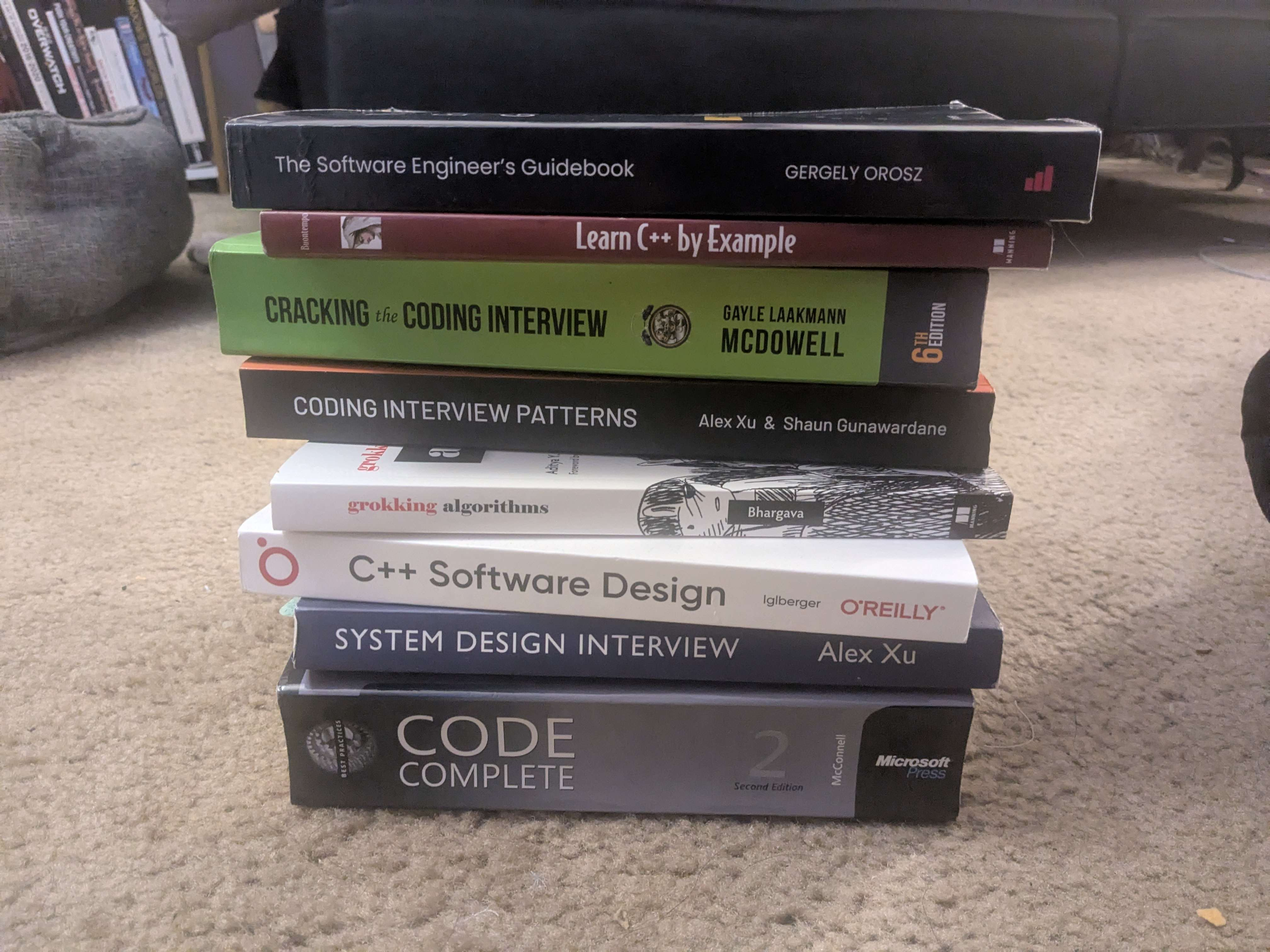
Code Complete, by Steve McConnell

An absolutely massive book of 900 pages… this was kind of a… weird? read, honestly, despite how popular it is. The text shows its age, having published in 2004. The book feels like it leans towards more theory, more about the processes of software development. While it may appear comprehensive with how fat this book is, it really is just an overview of dozens of subjects. There’s a lot of sections that I feel are more geared toward junior developers (I had actually bought this book during my first year out of college, and while I hadn’t gone through the entire book at that time, I did feel like it was more helpful then). Overall it felt like everything was a nice refresher, but nothing really felt new to me, nor did it feel too helpful in regards to interview prep.

The book starts with software construction and high quality code. Focus on construction, requirements, design. Define your coding conventions as a team. Write code for humans first. Code defensively, but not too defensively. Lay out your code structure starting with pseudocode. These are pretty important, but pretty general concepts overall. As a senior engineer you’ll know about all these, but it’s nice to go over how you can improve on this. As a junior engineer, these might not be as relevant since you’re often not the one making the initial design, requirements, etc. In regards to interview prep, this helps a bit in focusing more on the bigger picture, like double checking your requirements before diving into a interview question.

Then there’s the basics of actual programming, variables and statements. Variable names (make sure they’re clear and make sense), data types (avoid overflow, magic numbers, check for potential off-by-one errors in arrays), if-else statements (is the nominal path clear), and loops (are you using the right loop) – these are really quick skims, probably even for junior devs. I could’ve skipped these chapters entirely, but skimmed through it in case they had random useful tidbits of info (I don’t think they did).

Then it goes into concepts of code improvement and craftsmanship like quality assurance, pair programming, testing, debugging, refactoring, using programming tools, layout and style, writing self-documenting code. All nice to know, and again pretty broad subjects in general. But nothing really in terms of interview prep.

Overall a book I could have passed, but at the same time I’m glad I had time to churn through such a book that everyone has praised so much about. Unfortunately that praise was from over 10 years ago. I still picked up some random tidbits of info here and there. But man, 900 pages haha.

System Design Interview, by Alex Xu

This was a book that every senior engineer seemed to recommend – however, it didn’t seem too useful for me who’s more in embedded development. Majority of software engineering jobs are web-based, with a significant need for scaling to handle millions of users. But this isn’t the case for embedded software where only one user, if not a few, will be using it at a time. It also doesn’t help that literally every content creator in tech works for web (including all of FAANG), so there was a HUGE emphasis on studying system design.

Either way, I thought this was something I should prepare for, as I was looking for senior positions after all. Maybe it was just something I missed out on while with my last company. It turns out however that my skillset actually barely carries over to web services, where you also need to know databases, cloud platforms, distributed systems, and more. Even if they used the same languages that I knew (primarily C++ and C#), it didn’t matter if I was missing everything else. Because of this, I ended up not having to answer any system design questions after all.

Regardless, I felt like preparing for this felt really beneficial in general senior level thinking. Understanding the scope and requirements of a problem, start answering the problem at a high / broad level, then really honing in (deep dive) on a module. Knowing what kinds of questions you should ask the interview regarding clarifying assumptions, and understanding how to make assumptions given a lack of info.

C++ Software Design, by Klaus Iglberger

This was my favorite out of all the books I went through. I learned a ton about software design and architecture, SOLID principles, and design patterns. The author made the book a pretty fun read as well, e.g. with some poor dad jokes here and there, and things like “…your favorite programming book, like this one!”

Regarding SOLID principles, this was something that I only kind of knew about, but never truly understood at a fundamental level. This is actually a HUGE red flag for a senior level engineer. But in my first project out of college, majority of my coworkers were similar new grads, and the senior devs never brought SOLID up at all. Similarly with my second project, majority of my coworkers had about the same amount of experience as me, barring one coworker who had over double. The second project was however more about improving upon a legacy system, not so much designing a new system from scratch. Overall, the lack of exposure to SOLID principles over the years might’ve been the most detrimental part of my growth as a software engineer.

Iglberger however breaks down each principle super clearly, teaching us how code that doesn’t adhere to the principle is bad, and how the principle makes everything so much nicer and easier. Majority of it comes down to preferring composition over inheritance, using interfaces and passing them in to classes. Prefer how things are done, rather than what is done. Abstraction over implementation. All of these concepts complement each other so well, especially in the way the author presented them.

Then he breaks down design patterns, explaining how they can be really useful (and also how they can be detrimental). Majority of design patterns make maintainability and readability easier, at the cost of a bit of performance. They also make collaboration among teams easier, assuming the team is aware of those design patterns (and if not, it makes a great learning experience for them). Similar to my experience with SOLID, it was rarely brought up by coworkers, and it doesn’t help that the second project was on improving legacy systems.

These concepts were ubiquitous across interviews, and rightfully so. No wonder I was zero luck when starting out on my interviews! Fortunately this was one of the first books I read after getting laid off – and even more fortunate in how I even encountered this book in the first place (I don’t even remember). After this book, as I interviewed more and more, I got more comfortable answering these questions. Maybe half of them asked about SOLID, and a quarter asked about design patterns.

My first time making it to the final round of an interview process happened before reading this book – I think I would’ve gotten the job if I read it sooner. They asked about my familiarity with design patterns, in which I said I barely had any. I asked that interviewer for examples, hoping to learning more about them in that moment (and presenting my curiosity and desire to learn – they noticed this as well and were more than willing to cooperate), but it was still the weakest part of my interview that day. Everything else went extremely well that day.

Knowing that design patterns were a major gap in my knowledge, I went out to seek a book on them, which was how I found this book. I went through it, and then had a second opportunity where I made it to the final round. They asked about design patterns as well, and I was able to explain several patterns (I think I broke down Strategy and Bridge) as if I had used them my entire career. My interviewer only had one response…

Unfortunately I still didn’t get that offer, and I wasn’t sure at what I was lacking that day. It was a pretty easy interview overall and answered everything correctly, so I think it could’ve been a matter of just answering the questions more confident and/or quickly compared to the other interviewees. Regardless, seeing this improvement thanks to going through this one book was an amazing feeling, and I knew I was on the right track.

Grokking Algorithms, by Aditya Y Bhargava

This was another book that was brought up everywhere online, so naturally I had to take on this book as well. However, I felt like I could’ve passed on this one as well. Majority of the concepts felt like they were made for junior engineers. On top of that, the book overall felt like it was written for non-programmers (so that algorithms become less intimidating), so the author didn’t really go too in-depth into them.

The first half went over simple algorithms like sorting, recursion, and hash tables. I was already super confident in these concepts, and with how the book was designed and written, I didn’t learn anything from this personally.

The latter half involved way more complicated algorithms however, including Dijkstra’s algorithm, dynamic programming, and greedy. Despite how complicated those are, they didn’t go too in-depth, instead just going over them as an introduction. I also didn’t expect interviews to go over such complicated algorithms (besides greedy) unless if I was going for a FAANG-esque company, which I wasn’t. I went through these chapters regardless and felt a bit (just a bit) more comfortable, though I knew I needed to practice them later on. Either way, I was never asked these types of questions in any interview.

Coding Interview Patterns, by Alex Xu

This was written by the same author who wrote the book on system design. Coincidentally, I had just finished that book around the same time that this book just got published, in November 2024. Despite how new this book is, thus with no reviews, I gave it a shot. After all, his book on system design was really helpful, and so was his content on ByteByteGo which I started skimming through after discovering the former.

This book is basically LeetCode in book form. Each chapter covers a specific algorithm, ones that aren’t covered in school but are common in interviews. Examples include 2-pointer, sliding window, prefix sums, backtracking, and more. I actually needed a nice, structured introduction to these concepts, and having them in this neatly packaged book was perfect for my needs. They didn’t cover over basic data structures – it assumes you already know enough of that, especially since there’s hundreds of books covering those already.

Each chapter starts with a general explanation of the algorithm and how one would solve the problem. Then after the introduction, they provide several LeetCode problems, with a solution written out exactly like the Editorial tab on LeetCode. You could argue that you could just go to LeetCode itself and practice those problems (I of course did while/after finishing this book), but I really appreciated the structure of this book – I think that really helped a lot in retention personally.

Cracking the Code Interview, by Gayle Laakmann McDowell

The classic… I had gone through this book while looking for my first job, and so I might as well go through it again since I already have it on my bookshelf. Turns out it wasn’t that helpful for me actually. This book focuses more so on data structures, with interview questions focusing on how to best use them. I think this is more for junior level roles – more senior level questions would be algorithm and pattern-based like what Alex Xu covers.

Alternatively, it could be that the overall difficulty of interviews have just gotten harder since this book was published back in 2008. Regardless, I gave this a quick skim, and it was a nice refresher as I started getting back into interviews.

Learn C++ By Example, by Frances Buontempo

I had mentioned in my previous post that interviewers asked a lot of questions regarding Modern C++ – this book was the solution, breaking down each new feature from C++11 to C++23. I had just discovered this book around a month after it was published in April 2024, and it looked like it presented itself to me just in time. I hadn’t actually been asked of any Modern C++ questions yet, but I did notice a lot of job listings requiring Modern C++ experience, so I decided to give this book a shot. I think this ended up being either my 2nd or 3rd most helpful book – it offered a LOT that I was missing out on.

The book starts off with pretty basic features, such as auto and ranges. I learned how “auto” is more than just convenience – in fact, convenience is literally the weakest reason as to why you use it. It’s a lot more than that; a lot of it comes down to abstraction. I also learned the rule of AAA, or “Almost Always Auto”, and was so surprised on how I nor any of my coworkers had never heard of this rule. But alas it’s actually omnipresent in any project that uses Modern C++. Ranges then go over iterating through for loops without an indexer variable, i.e. basically a “for each” in C#, or “for” in Python (without using range()), and why they’re preferred over the classic for loop.

They then went over optional, equivalent to a C# nullable type (e.g. “int?” type, which can be assigned to null). Ratios, suffix literals, and variants (also with visit). All these little things add up.

Lambdas were described in great detail as well. I had used them a little bit on the job previously, but never actually looked too deep into this subject. Learning how lambdas make implementation more flexible and more loosely coupled was the biggest takeaway here; practicing the actual execution of writing up lambda functions was extremely helpful as well.

Requirements and concepts introduced the idea of generic programming, making templates more restrictive, thus more readable and actually more flexible. The compiler is able to catch more errors when using templates, which is preferred over runtime errors that are much harder to catch and debug. Generics make a SIGNIFICANT part of Modern C++, so much that I feel like I need to go through an entire book dedicated to this subject. (I was looking into the book “C++ Templates: The Complete Guide” by David Vandevoorde, but this is a fat 800+ page book, plus interviewers had never actually asked me on generic programming, so this wasn’t high on my priority list. I really want to get to this soon though!)

Smart pointers (and RAII) were probably the biggest thing for me. Before reading through this section, I had been asked about smart pointers a few times in interviews… and it was clearly a red flag that I didn’t know about them. After reading about them… it was clearly a red flag in my last workplace in how it was never brought up there. There’s almost no reason not to use them either. I think it was just legitimately nobody on the team knew about them.

They also introduced new data structures, unordered maps and sets. These are basically optimized maps and sets, since majority of times you actually don’t need the data in these structures to be sorted. I had indirectly learned about these earlier on as I churned through LeetCode and saw how every solution used the unordered version. Regardless it was nice to read through an official lecture on these new data structures.

Coroutines were really complicated for me; I definitely need to revisit this concept soon. This basically allows multitasking within a single thread, using co_await, co_yield, co_return, and promises. This section was definitely a loaded one, but fortunately I hadn’t had any interviewers ask about this.

Parameter packs (using “…” in function parameters) seemed like a nice-to-know more than anything – a template parameter that accepts zero or more arguments. This replaces having to write multiple overloaded functions, making code more flexible and reusable. Just a neat way to improve your code, not a must unlike most of the above concepts.

All in all, this book was extremely helpful! This was also before I discovered “Effective Modern C++” by Scott Myers, which seems to be the book for Modern C++. I plan to go through this book soon too later this year.

The Software Engineer’s Guidebook, by Gergely Orosz

This book isn’t so much for interviews, but more so on what makes a software engineer a senior level one over a junior. It felt like a book I actually should’ve read as soon as I got an offer, knowing how to best tackle the new role. Nonetheless, now that I do have an offer!, there are some nice takeaways for me to try when I start work in just a few days.

It breaks down different career paths and different types of tech organizations, and how you can thrive in each unique environment, so I’d be prepared for whatever company I’d end up in. Similarly, it breaks these down even further, depending on your level of experience. It goes over tech lead and staff positions, but I’m not at those levels yet so I skipped on that. Basically it presents a roadmap for your future career, which I really appreciate.

The book also emphasizes heavily on recording the work you’ve done, week after week. He calls this a brag log, which helps for promotions as you show them to your supervisor in performance reviews to objectively list everything that you’ve done (including times when you’ve helped coworkers, when this may not be covered in JIRA tickets). This was my biggest takeaway from this book, as it’s definitely something I wish I had so I could better present myself in interviews and really hone in on specific problems and solutions.


And that’s everything! With over 2000 pages worth of knowledge… it’s been quite a year. I learned way more about software than any other year in my life, including college (since it’s usually combined with non-software classes) and employment (small nuggets of wisdom here and there accumulated over the years, coupled with raw experience). As I interviewed more and more, I learned what knowledge I was missing and what exactly I needed to learn to even stand a chance. And now that I have… I can’t believe I missed out on all this over the years. It makes me feel almost embarrassed, to be quite honest.

That said, that shows just how important it is to continue learning outside of work. I really need to dedicate time outside of work hours just learning what the rest of the tech world up to, watching videos and reading Substacks to see what I’m missing. And from there I can see what books I could find to fill in what I’m lacking. I never gave any priority to this outside of work, but now that I’ve been… traumatized, by how much I was missing, now I know haha. Better late than never at least!
A Forced Gap Year In the World of Tech [Part 1: The Questions]

In November 2023, I was part of a company-wide layoff that affected hundreds of employees. It was a layoff that nobody on my team saw coming, not even my own project manager, who was so irrationally angry for me when he heard I was the only one on our team getting let go. I had worked there for over 8 years, as my first and only job out of college. Needless to say, I had never experienced anything like this.

Nearly 20 months later, I finally got an offer! With that out of the way now, I’ve been thinking a lot about the journey I’ve been through over the past year half, with how much I’ve struggled, how much I’ve learned, and just thinking about how merciless the job market is today.

I had left the company completely underprepared. I thought I was learning a lot about software, especially from senior engineers above me whom I talked to and worked with every single day. I was getting comfortable with writing code the way my fellow engineers did. And I was seeing common patterns when debugging issues and navigating through hundreds of files of a codebase, especially in the scope of the domain I was working with. But after going through a couple of interviews, it showed that what I knew barely mattered.

I hadn’t interviewed for other companies throughout that time, as I was really enjoying my time working there and felt like I was learning something new every day, even 8 years later. I thought I would’ve been fine going into an interview with just a bit of prep here and there, some LeetCode for a few days, looking up common software engineering interview questions, and I’d be fine. I wasn’t planning on going for FAANG, and I had a pretty easy time interviewing for my previous employer. It should be fine!

Well, with the title of this post here… clearly I wasn’t fine.

I realized that majority of my technical knowledge, I had rarely if ever actually explained to another person before. It’s really weird to know something that you work with every day, yet you can barely put it into words because you’ve never actually had to after nearly a decade. Relatively simple things, like in threading explaining what a critical section is, or in networking explaining the difference between sockets and pipes – these are all pretty basic things from college. But I could barely articulate my thoughts. It was like trying to translate whatever foreign language was in my brain, into English. Even if I was able to explain it, my confidence in my answers were so low just because it wasn’t a question I expected (plot twist, I didn’t know what questions to expect because I hadn’t been interviewing). And confidence is EVERYTHING.

Then they started throwing questions about concepts I had never even heard of, but were expected of me as I applied to senior roles. I work primarily with C++, a language that gets updated with new features every 3 years since 2011. For any version of C++ starting that year, we call it Modern C++; older versions were called Classic C++. My workplace had really only worked with classic C++ (technically Modern C++ from 2014, or “C++14,” which our C++ framework was working on, but nobody on our team actually mentioned the term Modern C++ at all.) We’d casually use some Modern C++ features like the keyword “auto” and range loops – really just for convenience more than understanding why they’re preferred – but nothing more. However, interviewers started asking me questions, like what is RAII? What are “concepts” and “promises”? What’s an anonymous namespace? What about generics?

In hindsight, I feel like I deserved to not get hired because genuinely every C++ programmer in 2025 should know about these things – but I had simply never been introduced to them. This did expose one significant thing about my career however: admittedly I had paid very little attention to the tech world outside of work. I was one to think, oh because I’m learning so much on the job every single day (genuinely), for 40+ hours every week for so many years, I don’t need to keep up with what the rest of the world was doing. This was probably my biggest red flag honestly, and I sure was in for a rude awakening. It also showed how outdated a lot of our practices were at my last company (the average employee is fairly old for tech, maybe around their 40s.)

Some other questions they asked included things like design patterns: something I absolutely should be familiar with as a senior level engineer, but with 80% of the job being maintenance and debugging work, I wasn’t. Similarly, build processes and compilers: things that while we use every day, we barely work on it directly ever, especially when projects are all about improving legacy code.

Oh and don’t forget the LeetCode style questions! Where everyone says oh as long as you can solve medium difficulty questions you’ll be fine. Surprise, every other company is asking a hard difficulty now. And you don’t even solve these types of problems on the job, not even the medium difficulty ones. Converting binary trees into linked lists in an interview when your day-to-day job is mostly finding bugs and maintaining legacy code? I don’t even think I’ve used a tree a single time while employed. Relearning all that definitely took some time, on top of learning common interview algorithms like greedy, prefix sum, etc.

And lastly there’s those niche questions that you don’t need to truly understand the ins and outs of in your everyday work. Things like explaining the virtual table, the heap, garbage collectors, etc. I’m familiar with them and know when they’re being used, but fully explaining them like I’m a college professor… admittedly not so much.

I do think demonstrating a willingness to learn and a genuine curiosity can go a long way in interviews, and most people both interviewers and interviewees would agree. Whenever I did get such a question, I’d answer something like “I haven’t heard of that before, can you explain? I’d love to know more about it.” And more often than not, they’d be happy to explain (and this accumulation of answers helped me a LOT over the long term). But results wise, there was never another follow-up interview. Not in 2024 where competition is tougher than ever, that’s for sure. Some interviewers would just ignore my interest and say “no time, next question,” so I KNEW it was over.

Over the past year half, I knew I had to maintain a strict schedule in juggling books, interviews, job applications, LeetCode, actually building side projects, and catching up on the tech industry. I believe structure truly defines how far you’ll make it. ESPECIALLY when you’re unemployed, when it’s easy to go “okay let me just do that tomorrow” because you have all the time in the world.

To really get comfortable with these questions, especially with how broad and varied they can get, it felt like I had to prepare for a final exam. But instead of it being a final exam of a single course, it was the final exam of every single subject you took in college. I ended up resorting to flashcards – creating nearly a thousand of them, ensuring I could not just remember (and of course fully understand) the answer but also physically say the answer out loud while staring into my webcam. I started small and gradually added more and more, but it didn’t feel like it was helping for weeks. I think it was finally showing results however maybe four months in – admittedly however, I didn’t put as much effort in this compared to everything else.

Something else I had to work on steadily over the year – my actual speech and communication skills. Learning more about pacing, hand movement, smiling while talking, pauses before/while you talk, thinking out loud (this especially was a huge killer for me), constantly sitting up straight for confidence, etc. A lot of this feels SO awkward to me specifically when talking to strangers, especially people of authority. Practicing all this might have been harder than everything else mentioned honestly – it just felt so unnatural for me. Watching a video on speech (not just for interviews but in general too) on at minimum a weekly basis absolutely went a long way, but MAN was it SO uncomfortable. Pair this WITH actually answering the interview questions to the best of my ability, and it’s actually so much for my poor introverted brain to juggle. But it’s definitely gotten better over time!

All in all… it was a struggle… and I’m not excited for the next time I’m forced into the job market again. I feel like being able to maintain this knowledge, these skills, over the next couple of years for whenever I start interviewing again, is going to be key. And that’s going to require a lot of discipline as I go over all this material week after week, or maybe as month after month, for who knows how many years. But with the job market being tougher than ever, and layoffs still going on in current years, it’ll be a must if I want to go into the next job hunt prepared.

In future posts I plan on thought dumping on the books I studied, as well as the general interview process and job hunt. Stay tuned!

Switch 2 LA!

  1. The Experience
  2. Mario Kart World
  3. Free Play
  4. Donkey Kong Bananza
  5. Mario Party Jamboree
  6. Split Fiction
  7. Metroid Prime 4: Beyond
  8. Hades II
  9. The End

WARNING: Spoiling EVERYTHING! My thoughts on my hardware and all the games. You can navigate with the anchors to avoid specific spoilers. I know it’s a long one too, so feel free to skip around!


I was so fortunate and privileged to attend the Switch 2 Experience! You could only sign up for this via a lottery system, and out of all the friends I know, I only know 3 others who were also able to snag a spot. I definitely lucked out!

IIRC the Nintendo website stated they allotted about 120 slots per hour, with 4-5 hour sessions per day, for 3 days. So in each city, they only accepted ~2000 people? I can’t believe even more so that I was one of them ;-;

The Experience

I absolutely enjoyed how well organized and streamlined this event was run!

They allowed registered attendees to show up 15 minutes before the scheduled hour (the one hour indicating when you can check in, not how long your experience is). When you get there, they let people in in groups of ~30 at a time. I ended up being third in this group of 30 (they had just let in another 30 right when I got there), and from there I waited about 15-20 minutes. So my guess nobody the entire weekend would have to wait any longer than that?

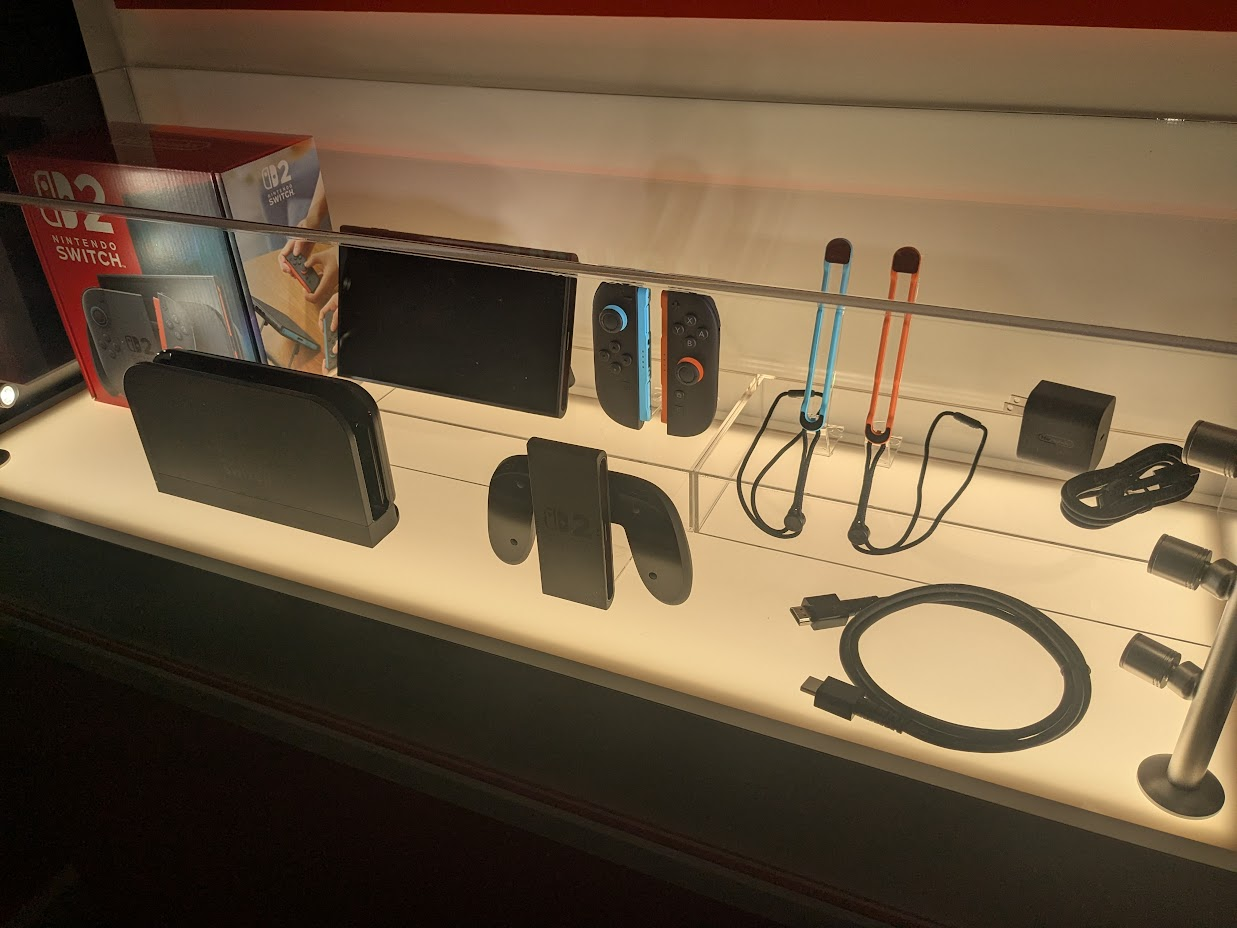
When you get in, they first give you a look at the hardware, including holding the Switch 2 itself!

Everything’s got a much more sleek and modern design. The inner parts of certain parts, e.g. the dock, have a glossy finish. Edges are rounder. It’s all so sick.

The console itself is nice! It’s not fully magnetic, as there’s a hold lock button at the back of the Joy-Cons to detach them (releasing the magnets). Those locks allow you to hold onto the console with your hand just on one Joy-Con. The size upgrade is definitely noticeable as well (for someone like me who plays on handheld often while traveling), yet the console still feels just as lightweight. Buttons feel sturdier. Control stick just feels a bit bigger, but otherwise not much different. A USB port at the top is going to be so convenient for charging, unlike the original where you need a portable dock to charge it while playing.

Mario Kart World

After about 15-20 minutes, they take you in to the first demo: Mario Kart World.

They divide this up into 2 sections. The first part has you pair up with a friend, or to meet someone new who also came solo / in an odd-numbered group. You get your hands on the attached Joy-Cons, racing each other on a 1v1 on a split screen.

The game has a lot more tricks, including the way you drift, barrel roll onto the walls, and more. It’s relatively complicated especially with how little time you have, but I’m sure it’d become second nature within an hour. Lots to play around with for sure!

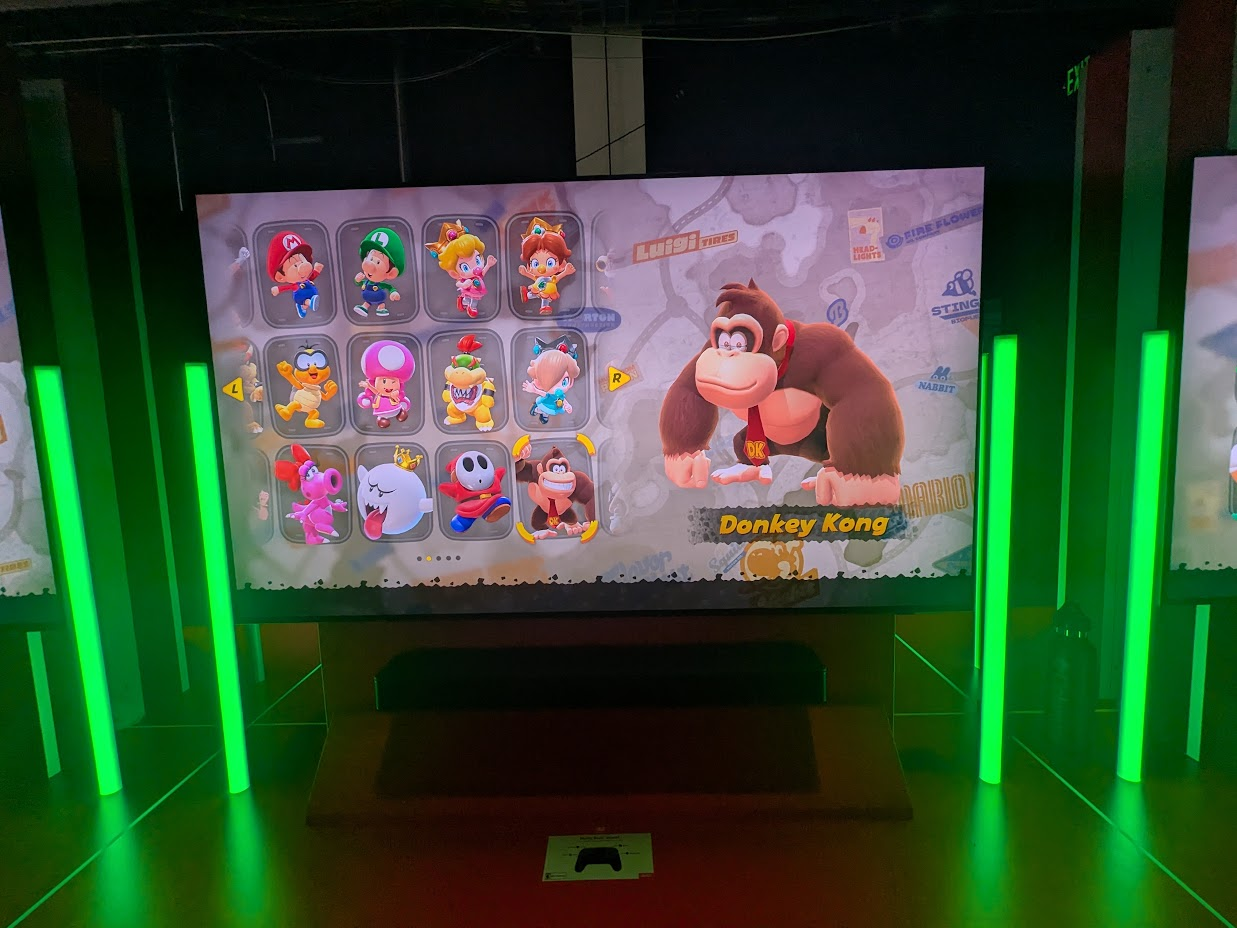
The character selection is pretty insane, as you all may have seen online already. But where’s Diddy Kong 😦

Maps are huge! I think majority of the courses are one long path, rather than during multiple laps, but I’m not too certain. There’s a lot of paths you can take along the course as well, notably using walls to access them.

Overall I’m just a super casual in Mario Kart and can’t say too much, but what I can say for certain is that they’ve gone above and beyond in this version for sure. Worth the $80? That’s another story… but it’s definitely worth more than previous versions, with how much content and care they’ve put into this game.

After the 1v1, you get to try out 1-player mode vs CPUs on handheld mode (they have separate consoles right next to the big screen). This lets you get a feel for the handheld screen. The screen I think looks even better on handheld? I’m not too sure but it felt even more crisp than when docked.

Afterward, there was a bit more time than expected so they let us do one more 1v1 on the big screen.

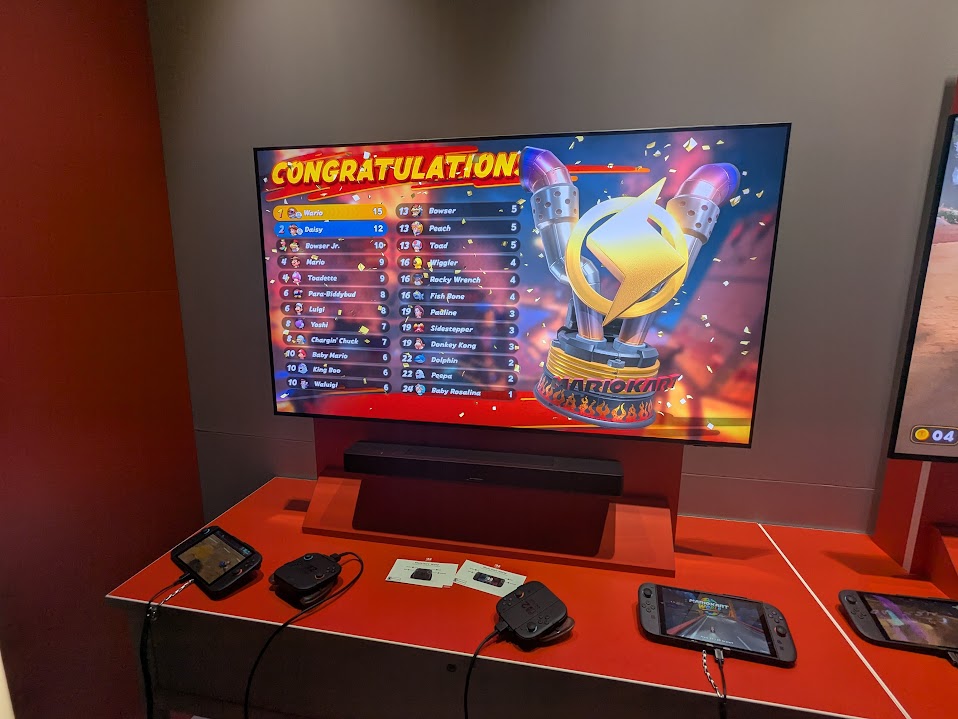
Next, everyone groups up to try out the Knockout Tour. This has you race through what feels like 6 courses combined into one super big course, with 24 racers all against each other. In this case, 24 consoles all connected via LAN. It gets SO crazy and chaotic, it was an absolute blast!

In this mode, the main goal is simply… don’t be last. The last 4 to be specific. After each leg, the last 4 get eliminated, repeating until the final 4 remain and they race to the finish.

While everyone is loading in, you can explore the open world, test out the new features, etc. etc. For a racing game, there’s quite a bit!

The fact that it’s 24 real human beings is actually insane. Everyone’s tossing items at each other, and they’re all so close to each other constantly. I kept switching back and forth between first and last place (1st to 24th…) depending on the items. It was SO stressful but so fun. My favorite part was whenever someone uses a lightning, and the entire room groans in unison LOL. I ended up in top 8, not bad!

If you get eliminated early, you can leave ASAP to the second half of the event… free play for all the other games! Or you can stay and watch how the knockout mode ends.

Free Play

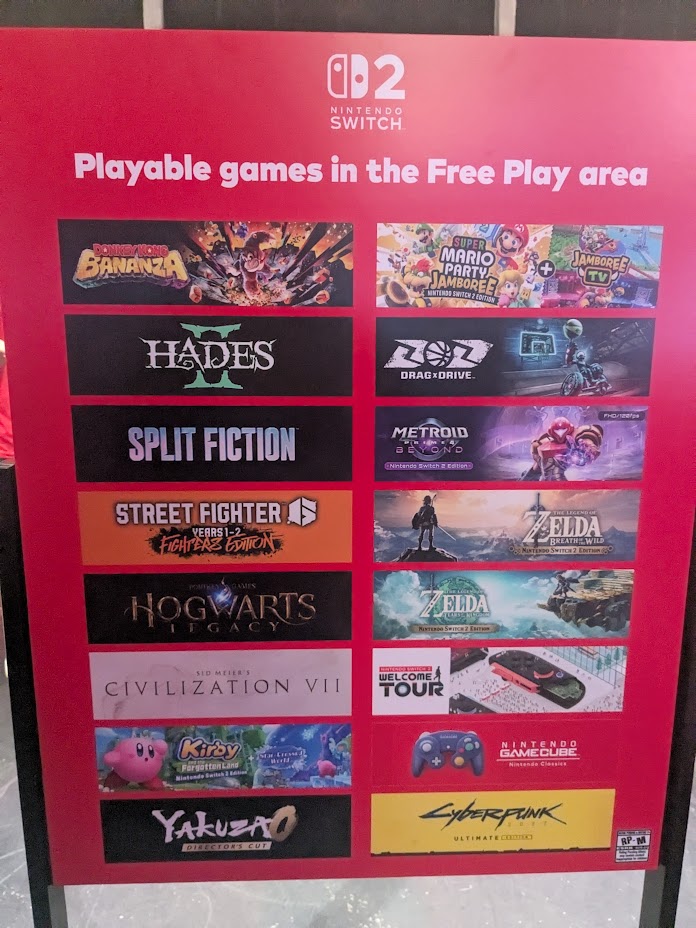
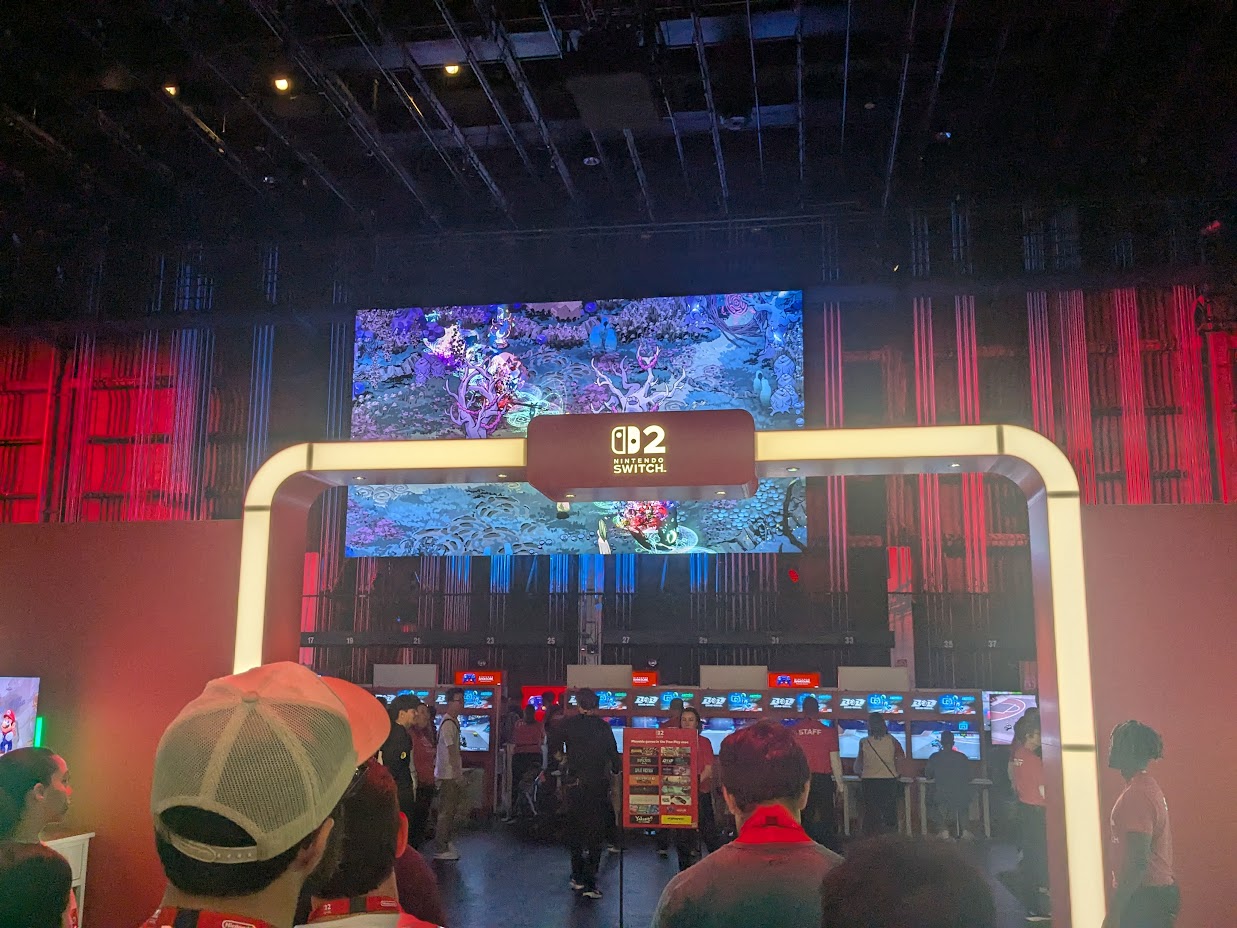
From here, they move you to the next and final room, where they have tons of setups for all the games above. Pretty solid variety here!

I ended up with DK Bananza (of course), Super Mario Party Jamboree, Hades II, Split Fiction, and Metroid Prime: Beyond.

While trying a new game, you’ll be filling out what’s called a Gameplay Passport. Your goal is to play 6 games, and every time you try a game the staff will mark your passport. If you fill up the passport, you get goodies at the end! Mario Kart and DK Bonanza however don’t count – it’s their featured games and everyone’s gonna be playing them regardless.

At this point, you have a bit under 2 hours to try everything you’d like. (It’s a total of 2 hours 20 minutes starting from when you start with Mario Kart.)

Donkey Kong Bananza

Of course, the first game I had to try was DK! At long last, over ten years later!! With their second featured game, they had dozens of setups available and it was not an issue at all hopping on one.

First of all, the Switch 2 graphics look amazing in this game! Everything is so contrasting with strong saturation (just the right amount), and the frame rate felt really good too, though admittedly I’m not the best at comparing these things in general. But the console truly gives this game justice, and I’m sure plenty of developers are looking forward to make the most of it in the future as well.

Everyone says it’s an Odyssey re-skin, and when experiencing the game live, you truly feel it. The exploration, the Nintendo whimsy, the various ways DK can interact with the environment, it’s all there!

DK is also as expressive as we saw online, and the graphics help in showcasing him in all his glory. This made me realize, his visual update I think is just objectively better? It really does allow him to be more expressive, and in his angry mode he looks just as edgy in the past, but better!

HOWEVER, I feel like majority of old-time fans’ actual issue is how much he’s losing his edge. He loses a lot of what made him special as a Nintendo character, and now he blends in a lot more with a lot of Nintendo’s IPs and their childlike personalities (which I think Nintendo’s intentionally doing). Thinking like Mario, Kirby, Pikachu, Villager, etc. I’m coming to terms with this update more and more, having played the demo now, but I miss the old one already D;

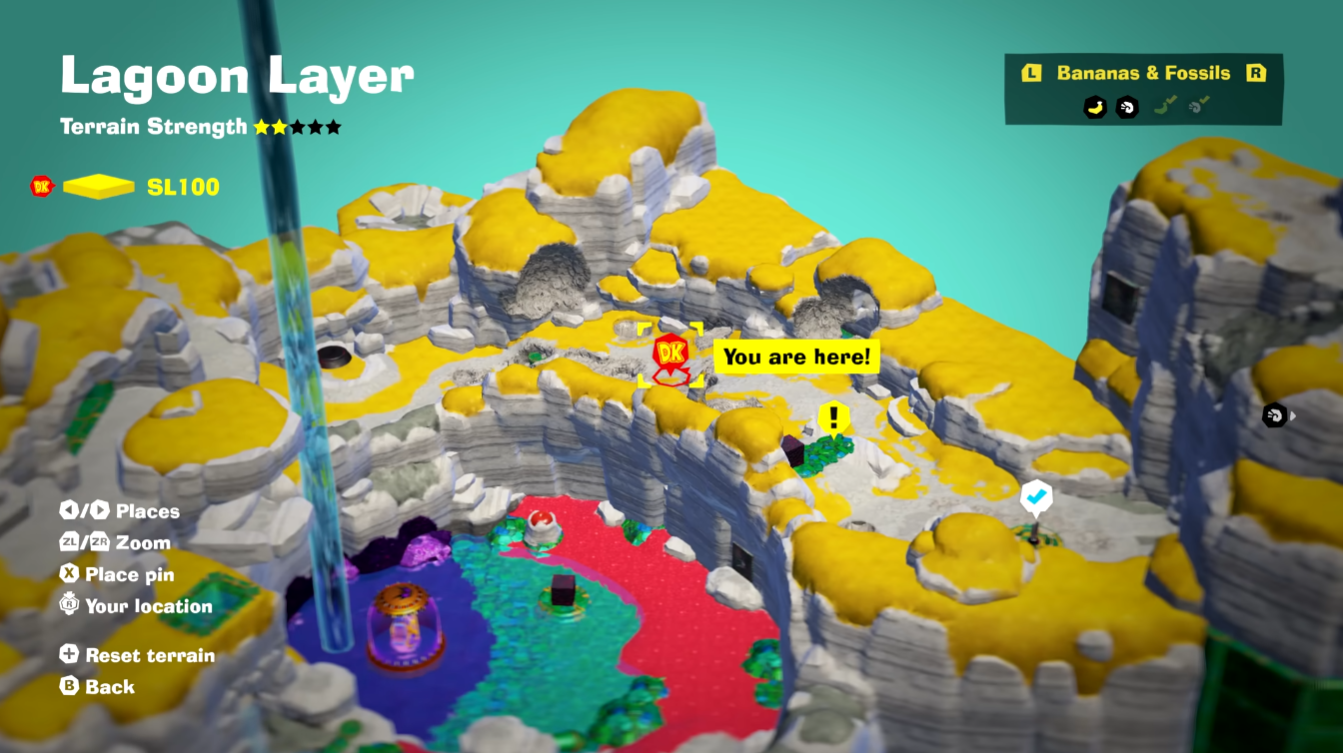
Regarding the exploration, I really love everything they did here! The biggest eye catcher IMO is how they created the map overview, remembering everything you’ve done to it. The technology needed to do this must have been incredible, transforming the level itself into this map view. Yet at the same time this will definitely be necessary, as there’s soooo many places to explore, and so many walls to dig through.

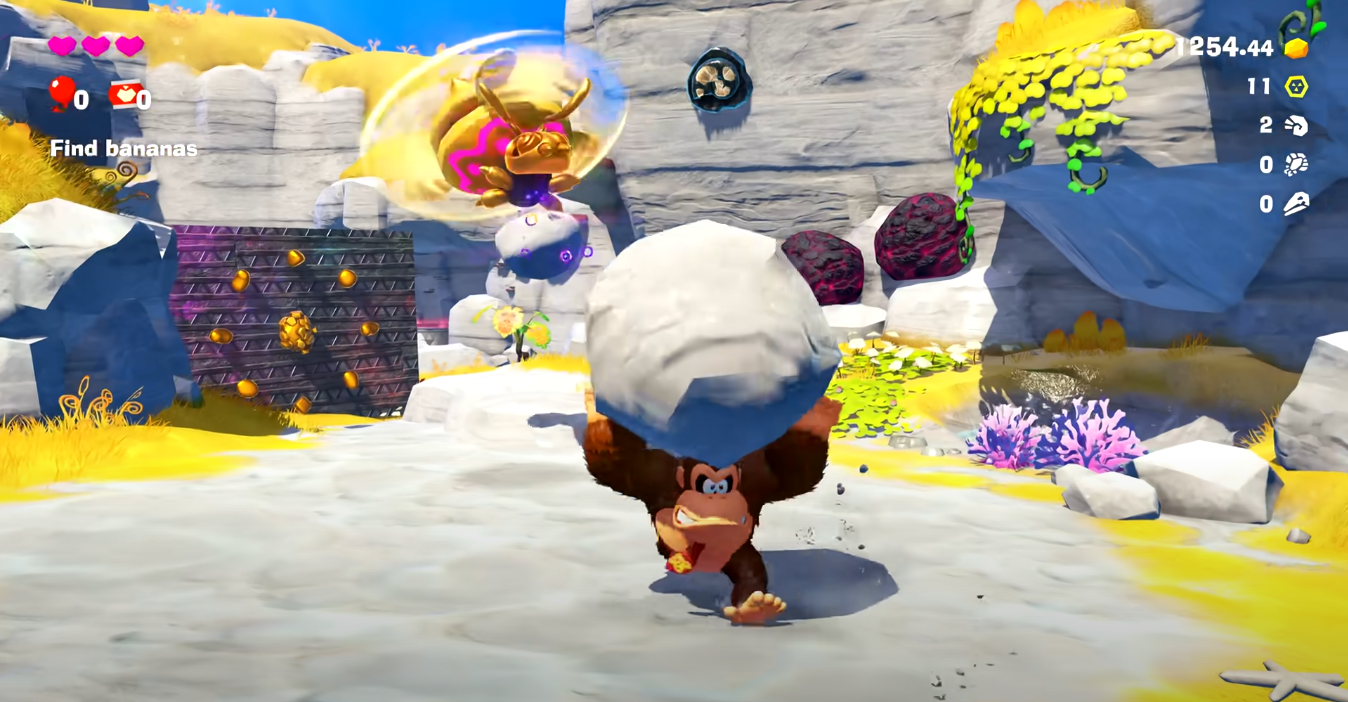
I do have a few qualms with the game however, with a few things you wouldn’t notice without playing the game yourself. I feel like the way you interact with a lot of things in this game are a bit unintuitive. A lot of legacy ideas got lost in translation into this new modern game, I feel. An example here, fighting against this flying insect, which I imagine is the new modern Zinger, see below. You can’t jump on it; you have to toss a barrel at it — or in this case, a rock. However, part of what gets “lost in translation” is the lack of conveyance that you can’t even punch it from below (even after the enemy tossed its rock). I don’t think anything hints this in the character design. It’s clear you can’t jump on it, with the spinning top, but nothing more. You kind of have to assume, oh you can’t fight Zingers head on in the past, so you can’t fight them head on with anything in this game either.

Something else I felt weird is how you can hand slap against the ground to collect nearby items (which is SO useful btw!), however it’s exclusively for item collection. It seems really strange to me in how it has zero effect on enemies. This is the opposite of “lost in translation” from prior games, where the original DKC games would defeat enemies, and in more modern versions (Tropical Freeze and Returns) it would stun opponents. Nothing hints this, and I just ended up dying for it lol. No big deal since you just respawn at a nearby checkpoint, but it’s all about the idea of conveyance which feels a little bit too consistent in my gaming experience.

One final example is with this key here, shown below. After defeating an enemy that holds this key, the key plops itself into the keyhole. The exclamation point then points to the face, so my initial thought is to break the capsule, the key now allowing you to do that. After punching all around it to no avail for about half a minute, staff just pops in and kindly advises, oh just punch the key. Something minor, but again it’s the consistency in the lack of conveyance, and I’m a little apprehensive in the quality of the user experience in the game as a whole. And it kind of sucks that you can’t notice these things in videos, since the players already know what to do and you’ll only see the right solutions lol.

Despite all this however! This is still going to be an insta-buy whenever I get a Switch 2 / on DKB launch day, as I think there’s still way more good than not. I’m still not sure if I’ll buy the Switch 2 on launch, solely depending on the price. We’ll see!

Mario Party Jamboree

This was a fantastic demonstration of the Switch 2’s mic and camera! They gave 3 mini games exclusive to the Switch 2 version. Staff said the mic can pick up audio from ~12ft. away, which actually seems really impressive. But there was only one way to find out!

The first mini game (randomized per usual) was this stacking Goomba game, using the camera and your head movement to catch falling Goombas. Gravity affects the stack itself, and Goombas can fall off even after you catch it, so it can be a bit tricky!

Second game was “Talking Flower says”, which was basically a simple version of Simon Says, again using the camera. “Blue team, stand! Red team, squat!” Unfortunately, someone wasn’t squatting low enough for the game to catch that, so the standing team won that round lol.

Last one was Bowser forcing us to put on a show. We simply have to move about and scream as much as possible, with the more energetic team winning. Definitely a fun mini game for home parties, haha.

All in all, twas fun! I’d get it if I hosted parties often, haha.

Split Fiction

For some reason I haven’t been paying attention to this game, but it has everything I like in a video game. Sci-Fi meets fantasy (aka Xenoblade… and one of the protagonists is named Mio…), action-adventure, and it’s all about two authors and their stories coming to life (the writer in me appreciates this haha). But I noticed the game looks beautiful in person (way better than the online trailers, thanks to Switch 2 graphics!), and I happened to find a setup open so I decided to try this out! A young father with his ~8 year old son came by soon after, and I ended up playing co-op with the son. Apparently he loves this game and has played it multiple times, and they both just wanted to see it on the Switch 2. The son didn’t talk at all while playing, but the dad kept advising both of us on what to do haha.

I hadn’t played It Takes Two, the first iteration of this tag team type of game, but I’ve always loved the concept of it. Trying it in person made it even better, as both players work together to figure out how to traverse a given path. The demo starts a bit past the beginning (I looked it up later, the demo approximately 45 minutes into the start of the game), which makes sense since the beginning is more exposition than gameplay, but forgoing tutorial elements making it a bit awkward for me to play. I was slowly figuring things out though, and the father was really kind as the three of us worked together.

I actually really want to play this game now, especially with all the amazing reviews on it on top of all the beautiful graphics. If any mutuals want to play, let me know! It’s cross-platform compatible, and only one person needs to own the game. The second person can play it on any platform after being given what’s called a Friend’s Pass. It seems to be a game to play together, and I’m sure the story itself is only going to get more exciting from here!

Metroid Prime 4: Beyond

This demo here was identical to the Treehouse version, seen here: https://www.youtube.com/watch?v=9W9xes7BZto

This was a fantastic demonstration of using the Joy-Con as a mouse! Being able to swap between mouse and controller by simply rotating your wrist felt so seamless. The extra precision you get from playing with the mouse feels so good, perfect for this first-person shooter game. As you use the right-sided Joy-Con as a mouse, you can also use the buttons at the same time, using the face buttons now on the left of the mouse. This took a lot of time to get used to (maybe I didn’t actually get used to it yet lol). Alternatively they mapped some actions to both left and right Joy-Cons (like jumping) so you don’t have to use the mouse face buttons.

Something that I kept doing by habit, was trying to use the right control stick while in mouse mode… like I couldn’t help but think it’s still a controller, not a mouse. But when it’s in mouse mode, the control stick doesn’t do anything. Not a complaint or anything, just a funny experience with how my brain tried to process something new.

The level was fun and fairly difficult to go through, at least for me who hasn’t ever played a Metroid Prime game before. Despite that, I really appreciated the growing difficulty throughout the level, slowly getting harder and harder as you learn and get used to the controls.

The boss fight was HARD! The demo showed them taking 5 minutes, but it felt like 10 to me… but of course they’ve played it multiple times, and me zero haha. (After watching the Treehouse now… I didn’t know you could absorb the health orbs…) Experience aside, the boss was tanky! You had to shoot at it a LOT. The whole thing was just so fun, I really enjoyed all of it.

My only qualm here is that the mouse didn’t feel ergonomic at all. I’m not sure if I was somehow holding it incorrectly? Like if my wrist was off or something. But I kept having to reset my arm every few minutes, or going back into controller mode, to avoid cramps. The innovation to use the controller as a mouse is so sick, but it doesn’t compare to actually using a real mouse.

It also makes me wonder how many people have a setup to actually use the Joy-Con as a mouse. Like if it’s on the large screen in a living room, how comfortable would it be using the coffee table for the mouse, when I presume most would just be relaxing on their couch haha. Playing it at the demo felt nice since it was basically a standing desk. And those who play the Switch on their PC setup won’t have a problem either. But just something to think about!

Hades II

I actually hadn’t played any prior demos of Hades II before, and seeing it available at this event got me so excited to try it out! In hindsight I shouldn’t have since it’s available on Steam already, but I couldn’t resist… I think I would’ve gotten more value going for the Switch 2 Welcome Tour, or even Drag x Drive, the actual Switch 2 exclusives. Unfortunately I only had enough time for one more demo, and it ended up going to Hades II.

Nevertheless, Hades II was as fun as ever! It’s been a while since I’ve played the original, but the most obvious improvement in my eyes was allowing to sprint (i.e. continue running) after a dash. Constantly dashing everywhere in Hades I felt a little bit mind-numbing, but being able to sprint, along with boons designed for it, makes it a lot more interesting. Unfortunately you can’t attack while sprinting, compared to multiple dashes in the original and attacking anytime. You’d have to stop your sprint, attack, dash, then continue into your sprint once again. Don’t think it’s a bad thing, keeping things more balanced. But it’s different for sure.

Not much else to say here. Game’s good as ever! Initially I wasn’t planning on buying this game, seeing how similar it is to Hades I (regardless of how good II is), but man is this tempting now lol.

The End

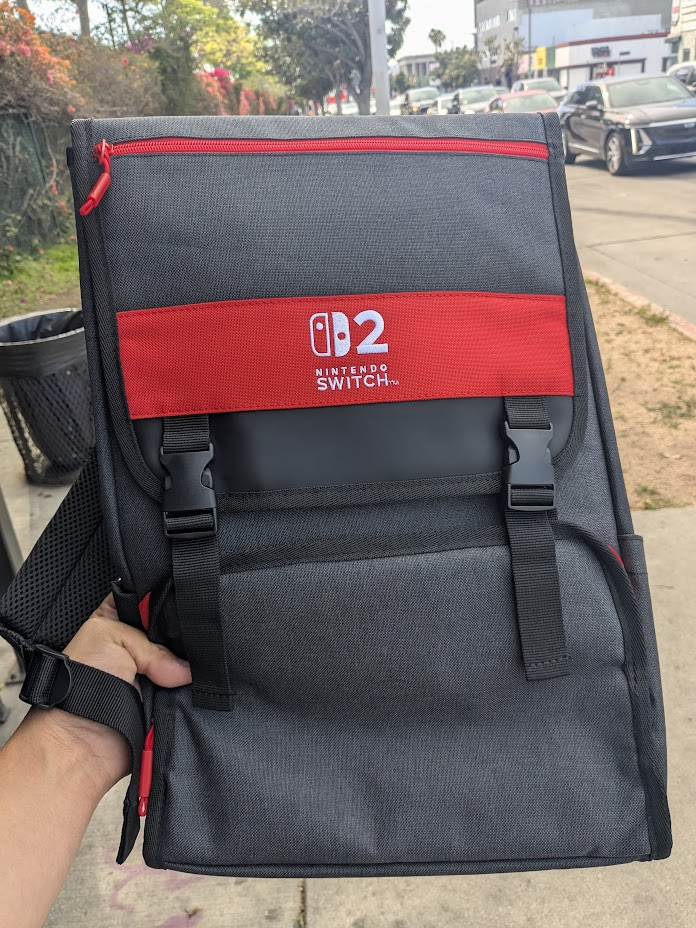
Alas, my allotted time is up. If you were counting the games, you’d notice I actually wasn’t able to fill up my passport! D; Fortunately the staff didn’t even check the passport (not sure if intended, since there were a decent number of people leaving at once) and they still gave me a reward after all. A free backpack! The quality feels amazing too, actually crazy how it’s free.

And that’s the end of my time here! An absolute privilege to spend my day here… and I’m glad I got to share it with y’all too. The Switch 2 can’t come soon enough. Thanks for reading!

A Year of Pyra/Mythra in Smash

Source: https://twitter.com/iDoodleKong/status/1473685259644375040

Yesterday, March 4th, marks the first anniversary of Pyra/Mythra in Smash. And with that, I’ve felt like reflecting upon everything that’s happened this past year. And oh boy is my head all over the place lol.

This year made me realize: this past decade I’ve been living a lie. DK DOESN’T TEACH FUNDIES AND MY FUNDIES ARE TRASH.

It felt like despite how long I’ve competed, I was starting all over again from scratch. My Aegis was consistently moving in and out of Elite Smash for maybe two months lol.

BUT THAT’S OKAY. WE LEARN, WE MOVE.

But holy WOW. This transition made me realize how defensive all my previous characters were, not just my DK. I started with Brawl Pika, who relied on thunderjolts; s4 Diddy with banana; Ult Daisy with turnips; Min Min, nuff said.

How to mash……

How to aggress… in a game where commitment is trash… with a char with pretty much all aerials being shield grabbable unless you have perfect spacing in a game with 98237428917439 moves that hurtbox shift. This is still a learning process.

Let’s also take away all the actual brain dead things DK had, that I finally have to learn in this game LOL

  • Reaction tech chasing (no more grounded down b)
  • Killing without grabbing at ledge at 100
  • No armor
  • No 0 to deaths with just one read
  • Having half the range with Mythra
  • Having the same range with Pyra, but with double the startup
  • Precision using 1/4th of DK’s active frames
  • Not dying at 0 because I put myself in the corner (because DK is fat, this never really happened unless I was maybe at 80%+, plus DK reversaling with cargo throw is broken so good players simply wouldn’t engage)

Aside from bnbs, I still feel like playing Mythra is unnatural. If I’m not in a flow state, I feel like a 1-2er. Outside of this flow state, I default to my DK-esque playstyle, which doesn’t work at all. (My autopilot Pyra is fine though, fortunately, great even tbh). Flow state Mythra however is absolutely beautiful and I love how well I can play with her. I actually feel like a god and feel like dropping DK was absolutely the right choice. Unfortunately reaching this flow state has been excruciatingly difficult for me.

The sunk time cost of learning the game in 2020… feels like a waste. Spent the first year of COVID breaking down a ton of matchups, maybe like 20+ chars, as DK. And with how different DK and Aegis are, only ~10% carries over, because DK is fundamentally flawed so he has to get creative in how to handle most situations in this game, which allows him to keep up with the rest of the cast. This was 200+ pages of notes wasted 💀 The video below is just half of my notes that’ve been made public to DK Discord — for one character.

“Mythra sucks on wifi!” was the death of me in 2021. Reacting to DI in near-frame-perfect combos, with such little hitlag and total frames, is near impossible online. Tech chasing on reaction is physically impossible. Wifi means mashing big, fat hitboxes is buffed, but Mythra can’t contest that head on, and of course whiff punishing that is severely reduced. Any hiccup on the connection is death. And with any more than the minimum online delay, I simply can’t move with Mythra at all. I don’t understand how I can get used to such a connection with Mythra, or if it’s even worth it.

I’ve had maybe only like ~15 offline tourneys with Aegis — some people play that often in a single month. Probably only 50ish hours offline. COVID go away please D; I haven’t even competed offline since November since my nearest local has been on a hiatus (rip), and my life situation has made traveling an hour+ to a local on a worknight unfeasible. Life is hard. Alas I do make sure I get some offline play against CPUs to practice such things, with specific goals in mind rather than to just win (e.g. tech chasing). But man does that get tedious haha.

With that, the grind on Quickplay continues. And holy wow the land of Quickplay is ruthless against the Aegis.

  • Days with 100% teabag rates (of 2+ hours)
  • Record of 8 DCs in a row
  • 2+ hours without rematches
  • Mutuals one and done me
  • One stutter = actual death, esp offstage
  • friend request -> “kys” — gotten ~10 so far

Regardless… my goodness I did not realize how much Quickplay I’ve been playing.

…But for some reason, everyone I play regularly has no idea why this is the majority, when they often say I’m the most fun Aegis they’ve played 😭

Individually none of those really matter, but when it takes up literally 95% of your playtime, life gets depressing, honestly. Arenas are goated but majority of the better players I’m friends with have conflicting schedules / avoid wifi unfortunately. And grind servers have been worse for me regarding overall skill levels and connections, especially since now I have no results to get into higher level grind servers rip lol.

With that and other factors… my morale has honestly been at an all time low.

  • Majority say they’re the easiest chars in the game and if you don’t think so, you’re worse than an 0-2er
  • Majority of serious discussion and vulnerable thoughts get cut off by “you play pythra”
  • Doing worse with a top 3 braindead ezpickup character than with a bottom 10 monke
  • I’ve killed my DK brand, and pretty much all my relevancy (every XC2 tweet drops a follower haha) — the raw numbers honestly don’t matter but it’s evident in how much my voice matters less (literally “just another pythra main” now)
  • “you can’t play Aegis, go back to DK PLEASE”
  • “why do you like the game of bad voice acting + degen booba + you play pythra + L + ratio + amogus”
  • “why are you struggling in a +2 MU”
  • “how do you keep LOSING with PYTHRA”
  • I’m SORRY I DIED for trying to dtilt your upB landing as Dark Samus AND I DIDN’T KNOW YOU BOUNCE TWO PIXELS OFF THE GROUND (See: https://twitter.com/kevinkaywho/status/1463093168920883201). It befuddles me in how I oftentimes can’t opt for my best combo starter and I have to consider factors like this into my decision making.
  • 0 notable results with them (majority have been very close at least! i.e. g3 last hit)
  • Losing as Aegis -> winning as Min Min felt like the worst thing in Smash. I’d rather lose the set than get a win with Min Min. Winning didn’t feel like winning. It felt like failure because I gave up on Aegis and only won because of that. I couldn’t do it with my dream char. (with that + the nerfs, I’m not sure if I still plan on using Min Min as a secondary… but I haven’t played her offline post-patch lol so we’ll see)
  • The decade of Smash feels more like a hindrance than anything. Not just for learning the game in the view of DK for a decade, and having to unlearn most of it… but people would say, you’ve played this game for a DECADE and you STILL can’t win with AEGIS 😭
  • I can get a SOFTWARE ENGINEERING DEGREE but I CAN’T WIN WITH PYTHRA LOOOOOOL. How BAD at gaming can I BE

(and when I say having to unlearn most of the game… I mean it LOL. See: https://twitter.com/kevinkaywho/status/1467943013800415236)

I know with how restricted my training has been compared to majority of SoCal grinding 2-4 locals/week – with chars they’ve played for years, I’ve accepted the fact that I’ll be behind. Does this mean I have to change my goals with this game? I’m still trying to figure that out.

All that said… Pyra is in Smash. This literal life-changing game is in Smash. The game that showed me a true passion for video games outside of Smash, something I’ve never had. The game that converted me into an artist (ty all who support my art btw ;-; It’s been coming such a long way), a streamer. And they’re top 1. AND they’re fun af!!!

I’ve never had that connection with DK, except for personality — and how bad he is made my brand lol. But with Pyra, everything truly feels like I have a purpose now. In my goals, in playing these chars specifically, in winning. Almost like I’m a discount Rex LOL. With DK, it was almost an empty statement of “Be the best I can be.” Now, I wish for this more than anything I’ve ever wanted in Smash. I feel like I can finally be my true self with them being in this game.

With that, none of the low morale matters. All of this is the journey I’ve always wanted ever since finishing Xenoblade 2. And I’m so glad this journey is possible. My Smash journey is my path to Elysium, and as the Twitter bio has said since this time last year…

We’re going to Elysium together. That’s a promise.

Thanks for reading 😊 (and sorry for the cheesy ending)

[Book Notes] The Plateau Effect

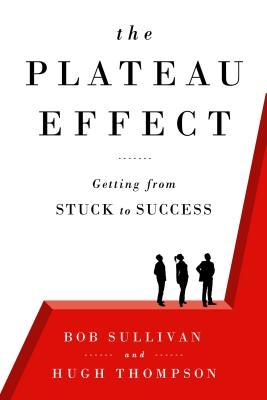
My notes on the book The Plateau Effect: Getting from Stuck to Success by Bob Sullivan.

16101017

Eight obstacles that cause plateaus:

  1. Immunity.
    Our bodies and minds get acclimated to everything after doing it repeatedly enough times (e.g. gym routines, diets). Mix it up!
  2. Greedy Algorithm.
    Going for the instant gratification instead of delayed gratification. Visualize long-term plans and goals, and commit to them.
  3. Bad Timing.
    Your brain might just need a break. Switch to another task / hobby for just a bit.
  4. Flow.
    May be missing the missing ingredient to initiate flow. Brainstorm, break up your task into smaller steps, look for creative solutions, etc, to solve the missing input to the step function.
  5. Bad Data.
    Data is all about context. You may be measuring the wrong things (e.g. may not be losing weight, but it’s been made up in muscle). Always double check the context and see if it aligns with your goals.
  6. Distraction.
    Stop multitasking, even if you think you can. It’s just excessive context switching. Focus on one thing at a time.
  7. Failing Slowly.
    Spending too much time on one thing, when in the end it may all be for naught. Experiment and fail quickly (failures are inevitable), so that you can find what actually works for you sooner.
  8. Perfectionism.
    The desire for perfectionism is usually a formula for procrastination. You may be focusing too much on the little details, instead of the broader picture (e.g. spending 80% of your time choosing a font, 20% on the rest of a graphic design). The key word we’re looking for here is satisficed: both satisfactory yet will suffice at the same time. All about energy / effort allocation.

[Gaming] Bravely Default 2 Demo…

It… might just be the worst game I’ve ever played 😡 I ended up completing the whole thing out of curiosity after about 5 hours, including optional bosses, and here are my thoughts on it all.

Characters / Story

  • Characters feel pretty average overall (despite the fact that Seth sounds exactly like Xenoblade Rex)
  • Story feels pretty typical as well: adventurers chasing an enemy over something valuable. Nothing too much to expect from a demo though

Environment

  • 3D models feel like they just don’t belong in the beautiful 2D art world 😡
  • Ton of empty space throughout the map, made exploring subpar despite how pretty the art is. Why can I explore the top half of the palace with nothing there
  • Why was there literally nothing interesting in the ruins

Menu

  • Who made the decision to hold the – button to view a description
  • Why you gotta wait 234987129834 years after equipping an item / skill to continue navigating through the menu
  • Why do the tooltips on items obstruct the view of the item below it
  • Navigating through the menu generally makes sense, but oh is it so cluttered with elements scattered among the screen almost arbitrarily (e.g. under the Equipment menu, navigating through the 4 characters is on the bottom right, but in the Jobs menu it’s at the bottom left. Under the Abilities menu, part of those characters are blocked by another window)
  • Thick black text stroke and possibly the worst font to choose
  • Windows are arbitrarily tilted at dutch angles, just making things look messy
  • Negative space is often either too much or too little, almost never just right
  • Why not just use Y to unequip an item instead of – in the awkward JoyCon / Pro Controller corner (Y was unused)

Overworld

  • Why is the field attack worse than DK’s jab
  • Why do you get no iframes when returning the the map from a battle, so you can be forced to fight twice in a row
  • Why can’t you tell how strong an area is (e.g. like a recommended level listing) without just dying, regardless of how close you are to the weakest enemy in the game
  • Why is cutting grass such a chore with how slow the field attack is
  • Camera on map feels very limited, sometimes obstructing the view of enemies dashing at you
  • Enemies chase you down VERY fast, so unless if you’re expecting one and there’s a lot of open space to run around / away, you will get caught and there’s nothing you can do to stop it. Some will even spot you when they’re not even on the screen, notably the wolves.
  • Why does the overworld go through night and day every 30 seconds, literally

Enemies

  • Why is the 3rd easiest enemy 29837498274893279x harder than the 2nd easiest
  • Why is the hardest wild enemy in the game (the bees) so close in proximity to the weakest enemy in the game
  • Why does said hardest enemy OHKO you, even when defending, until you’re like 3 levels away from the max level in the demo
  • Why do you have no idea how strong any enemy is until you lose to it
  • Why was grinding for multiple hours the majority of the demo a necessity — I spent 5 hours on the demo, and 3-4 hours were spent just grinding

Combat

  • Why do you not get to see anybody’s turn order
  • Why can you (accidentally or otherwise) select Default as your last action when you’re using BP, where Default would just override everything
  • Why is it that when you speed up the battles, the voices all collide like a cacophony at a bar at 4am
  • Why are the boss battles practically impossible unless you spam multiple mages and healers
  • Why can the bosses spam area-of-effect (AoE) skills with BP, OHKOing your entire party despite defending at full health
  • Why do you have to mash A literally over a dozen times to select the same move if using BP
  • Why do you not heal upon leveling up so you have to travel 5 minutes to the inn — every 5 minutes
  • Why can you not see your max HP/MP, only current
  • Can’t view stat changes / weaknesses / other important info without holding the awkward + button

Misc

  • Dialogue felt clunky, to where it seemed like some inputs to continue the dialogue wouldn’t register.
  • Party chat (when pressing + in the overworld) portraits seemed arbitrarily placed every time.

Things I did like!

  • The enemies and attacks actually look sick and smooth, compared the your party’s clay-like models
  • 2D art throughout the demo was fantastic — oh so wish that was used instead of the 3D protagonists
  • Town music and main boss music are pretty great, though like 10 minutes into the latter just feels like you’re playing DDR lol (not a bad thing) (all the other music was fairly average)
  • Job outfits are actually really sick. Black Mage Adelle is 2B, and Thief Adelle is Frozen’s Elsa :^)
All that said, I do realize that this is just a demo, and that the developers have it out to hear our thoughts on it all so far! But… why do I have 36 negative points compared to just 4 positive ones LOL.

I’m actually so bummed. This was probably my most anticipated game I saw from The Game Awards + the Nintendo direct where this trailer was first revealed, especially when all of the art shown was just the beautiful 2D art. But… I can’t see myself buying this game at all, no matter how much they improve the release version. I haven’t played the prior Bravely Default games, but I do hope they were nothing compared to this one 😡

“The Ultimate Notebook” 2nd Edition is now available!

smash-notebook-cover-2nd-editionThe second edition of The Ultimate Notebook is now available for purchase! Thank you for your patience! Check them out here!

Softcover: https://www.blurb.com/b/9948363-the-ultimate-notebook
Hardcover: https://www.blurb.com/b/9948345-the-ultimate-notebook

Changes in the 2nd Edition

  • Now includes the Fighter Pass Volume 2! Since this wasn’t announced when the first edition of the notebook was released, DLC fighters after Byleth weren’t included unfortunately.
  • Even MORE placeholder slots, just in case! Dataminers have found up to 16 potential DLC character slots, including Piranha Plant and the Fighter Pass Volume 1. So in addition to the Fighter Pass Volume 2, I added additional 5 placeholder slots, just so we can avoid a third edition if possible! (After Volume 2, there are 4 slots remaining, but I added one more for good luck.)
  • “Charts and Tables” is now “Detailed Tables.” After some feedback, the “charts” part of that section wasn’t really used, since important information would be read in the Matchups section instead.
  • Hardcover versions are now $45 instead of $40. I hate to make it even more pricey than it already was, but additional pages cost way more for hardcover versions than softcover versions, unfortunately. That said, softcover versions fortunately will remain at $20!
  • The book now has a total of 420 pages. Nice.

What if I’m stuck with the 1st edition??

I truly apologize for not having the first edition ready for all these new characters 😦 Feel free to contact me (easiest would be through Twitter), and if you can open up a receipt of your first edition purchase, I’d be more than happy to provide a free PDF of the 2nd edition, where you can at least print out the extra pages and use them however you’d like!

Best of luck on your Smash career!

New Decade, Same Me

Image
Happy New Decade! From @gonzarez1938

2019 Highlights

  • Smash majors: Genesis 6, Prime Saga, Smash n Splash, Breakthrough 2, Switchfest, Nightmare on Smashville, Kongo Saga
  • Made ~$500 (gross amount) in Smash! (without getting ranked lol)
  • Published not just one but two books!
    • The Human Behind the Controller
    • The Ultimate Notebook
  • Travels:
    • New: Wisconsin (Wisconsin Dells, Madison), Canada (Vancouver, Victoria, Calgary, Banff)
    • Other: Oakland x2, Las Vegas
  • Major events:
    • Second Sky (Porter Robinson)
    • LA Comic Con
    • DesignerCon
    • The Game Awards
  • Inktober x NieR
  • Books read: 6
  • Games played (5):
    • Tales of Vesperia
    • Final Fantasy VII
    • Cadence of Hyrule
    • NieR: Automata
    • Astral Chain
  • Movies watched (6)
    • Avengers: Endgame
    • Detective Pikachu
    • Konosuba
    • Promare
    • The Tale of The Princess Kagoya
    • Frozen 2
  • Races: Carlsbad 5000 (20K)

2020 Resolutions

Smash

  • Lab more (take ideas from DKcord)
  • At least one MU guide per month
  • Play more QuickPlay; yes QuickPlay is good!
  • Hit up character Discords for MU experience
  • Compete in a region I haven’t been to before

Health

  • Be more mindful of how much I eat
  • Run at least once a week (been doing cycling instead)
  • Keep up gym routine of 3+ / wk
  • Run in 2+ races

Lifestyle

  • Read 25+ books (~1 / 2wks)
  • Leave San Diego at least once a month for a full day (trips to OC / LA count)
  • Travel out-of-country ( ideally twice :0 )

Creative

  • Sketch at least twice a week (esp. using drawing book)
  • Practice using Line of Action (https://line-of-action.com) at least once a week (can be combined with goal above)
  • Draw at least one full piece per month (ideally 1 / 2wks)
  • Partake in at least one artistic event every other month (e.g. conventions, concerts, meetups)
  • Play ~4 video games (keep gaming outside of Smash limited, but don’t cut it off entirely because it still sparks inspiration)

[Art] Inktober x NieR: Automata

This year marks my second attempt… and success! at Inktober! (See last year’s Inktober review). While I had committed just as much time, if not more, as last year, it’s always worth it. And just like last year, I’d like to give myself some time to reflect on everything I experienced throughout this challenge.

I decided to stray away from the standard prompt this year, compared to last year when I tried to incorporate both that prompt with the Xenoblade 2 theme which felt a bit too restrictive (when a prompt is supposed to give you ideas on where to start, not be restrictive). Following the same idea of drawing video games, I decided to dedicate this past month to NieR: Automata, just having finished the game a bit over two months ago and loving every moment of it. I had such high expectations for the game, given I loved everything I saw about it from the artistic design to the characters to the music, and even then the game exceeded those expectations.

NieR-Collage---small
Collage of all my Inktober pieces put together!

Continue reading “[Art] Inktober x NieR: Automata”

[Notes] Atomic Habits by James Clear

40121378. sy475

I’ve just finished reading the book Atomic Habits by James Clear, and holy wow this is one of the most powerful books I’ve read in a while. Its lessons are so influential in everything in our lives, from our everyday habits to developing our skills in any field. I would highly recommend this book to literally anyone!

Below are the raw notes I’ve taken while reading this book, organized by chapter. Emphasis on raw, so pardon any typos! It’s quite a bit but I hope people find at least a little of it helpful!

Goodreads: https://www.goodreads.com/book/show/40121378-atomic-habits

Continue reading “[Notes] Atomic Habits by James Clear”